When teachers move, “license reciprocity” sounds like State B simply accepts a credential from State A. In practice, you apply to the receiving state, which evaluates your record and decides what credential it will issue. Your current license can make that review easier, but it does not automatically become a local license.
Start with the state where you plan to teach. Its licensing agency controls the application, eligibility, comparable grade and subject area, testing, and any conditions on the credential. The sending state’s website may help you collect documents, but it cannot promise what the receiving state will grant.
Three ideas people mix together
A state-to-state review pathway lets an agency consider an existing credential, preparation, and service from elsewhere. The receiving state’s rules decide whether this is called reciprocity, an out-of-state route, credential review, or endorsement. Some routes are one-way: State B may accept a type of State A license without State A accepting the reverse.
The NASDTEC Interstate Agreement is a framework that helps jurisdictions describe what they require of incoming educators. It does not issue a national license, and participation does not force every state to accept every certificate without conditions. The current agreement and jurisdiction-specific requirements are useful references; the destination agency’s application instructions remain the action list. A separate guide in this series explains the NASDTEC agreement in more detail.
The Interstate Teacher Mobility Compact (ITMC) is a different, state-law pathway. If the source and destination are participating jurisdictions and your certificate fits the receiving state’s compact route, you may qualify for a streamlined review and a comparable license. The participating-state list and implementation details change, so check the Council of State Governments’ current compact database and the state’s own application page when you apply. A state appearing on a compact list does not by itself establish your individual eligibility.
| Compare before you apply | State review / NASDTEC framework | Interstate Teacher Mobility Compact |
|---|---|---|
| What it does | Destination uses its own out-of-state pathway and requirements | Adds a state-law streamlined route for qualifying licenses |
| Who decides eligibility | Receiving licensing agency | Receiving agency verifies eligible license and comparable category |
| Application still required | Yes, under destination state process | Yes, follow destination state's compact application steps |
| Possible additional items | Tests, coursework, experience, records, fingerprints | Background check, application records, comparable credential match |
| Best first source | Receiving state's out-of-state certification page | Current CSG member list + state's compact route |
What the receiving state still evaluates
Before predicting whether you will get a full professional license, compare your record with the receiving state’s categories:
- Credential status: Is the current out-of-state license valid, active, renewable, and in good standing? Some routes require it to be active when your complete application arrives.
- Credential level: Does the source license represent completion of an approved preparation program, or is it provisional, temporary, emergency, or still deficient?
- Grade and subject match: Do the receiving state’s grade band, content endorsement, special education area, or student-services role match what you hold?
- Preparation and exams: Will the receiving state accept your approved program, test results, and student-teaching record? It may require a local test or allow an exception only after reviewing your experience.
- Experience: Does the route depend on years of successful teaching, the grade and subject taught, or an employer’s verification?
- Safety and disclosures: The receiving state can require an application, fingerprints, background check, or disclosure of disciplinary history.
Do not use a general reciprocity chart to decide a specific match. A state’s “professional” certificate may not be equivalent to another state’s Professional tier, and a broad K–8 endorsement may not line up with a new state’s separate grade bands.
Two state examples show the difference
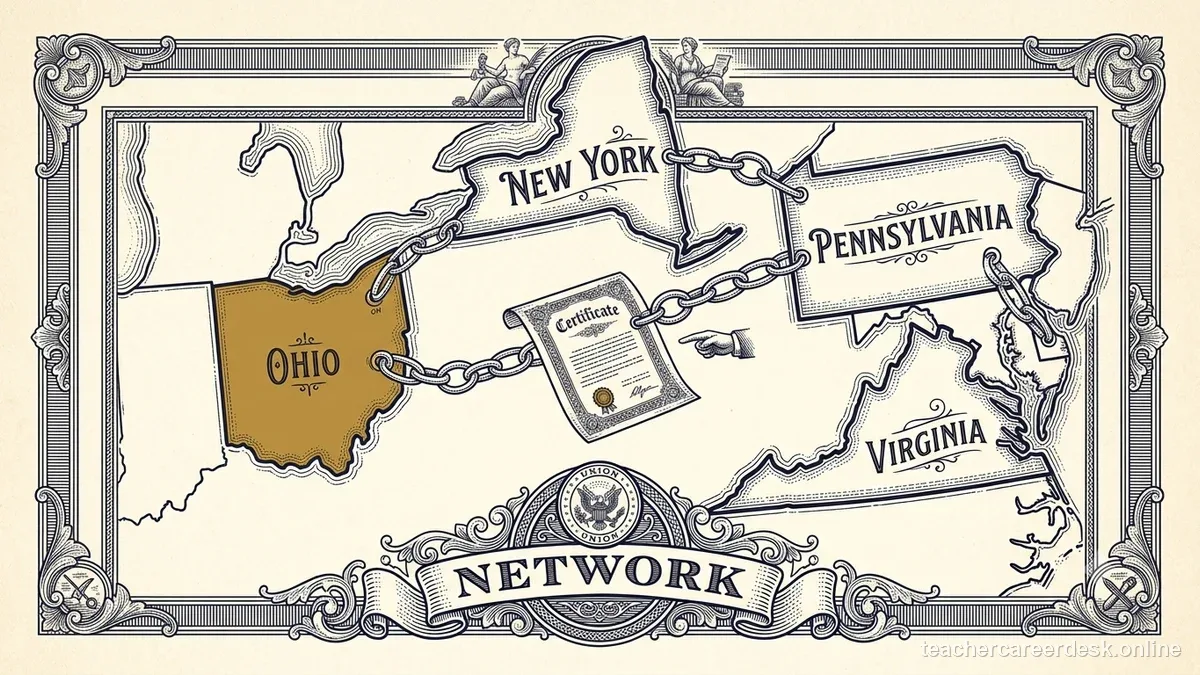
Pennsylvania has both general out-of-state routes and a compact pathway. PDE tells applicants to select the route that matches their current status. Its compact instructions apply to eligible, active/valid professional-level certificates from listed member states and ask the applicant to identify a comparable Pennsylvania certificate and apply in TIMS. PDE decides comparability during review; if the credential does not match, the application can be considered under another pathway. Pennsylvania’s current testing guidance describes a testing exception for qualifying compact applicants, rather than promising that every out-of-state applicant skips every requirement.
Texas describes its process as a review of credentials, not automatic reciprocity. An educator with a standard certificate from another U.S. state applies for a TEA review, supplies the certificate and official transcript, and may be reviewed for exam exemptions. Texas law now requires the out-of-state certificate to be both valid and active when the complete review application is received. A person without a standard certificate cannot use this review route simply by presenting an education degree or test scores.
The examples are deliberately different: a compact pathway can streamline one state’s review, while another state still requires a credentials review and has its own active-status and evidence rules. Neither is a shortcut around reading the destination state’s current instructions.
Prepare a receiving-state application file
Use the destination agency’s checklist, then gather what it asks for. Common items include:
- current license verification sent by the issuing state;
- official transcripts and approved-program verification;
- test results and, where relevant, student-teaching evidence;
- employment verification showing dates, grade levels, subjects, and successful service;
- identity, name-change, fingerprint, background, and disclosure documents; and
- the correct application, fee, and selected credential or endorsement.
Order official transcripts and license verification early; a screenshot or photocopy may not satisfy the agency. Keep proof of submission and monitor the new portal for deficiency notices. Do not submit an application for a broad title such as “teacher” when the state requires a specific grade span or subject.
Protect the source license until the new route is clear
Do not let the source credential lapse, surrender it, or assume an application receipt permits you to teach while the new state reviews your file. Confirm whether the receiving state requires an active source license on the complete-application date and ask when you may begin work. If the source license has expired, first check whether the receiving state’s route accepts it or whether you need to restore it; some destinations require a valid active credential.
After approval, read the issued credential itself. It may be an initial, provisional, temporary, or professional license and may include testing, coursework, induction, or renewal conditions. Calendar each condition and verify that the grade and subject areas match the position before starting.
License approval is separate from hiring and pay
The state credential does not set every employment term. Ask the district how it counts prior experience toward salary placement, whether it accepts service from private or out-of-state schools, and which background or onboarding steps it requires. Pension-service credit is also decided under the relevant retirement system. Treat those questions as separate from the licensing review.
Competitor review: what the broad guides miss
Castleport Test Prep’s August 2026 reciprocity dataset is the strongest reviewed competitor for documenting the difference between NASDTEC and ITMC; it also makes its verification date and source limitations explicit. LegalClarity gives a readable overview, but its compact count was framed as “as of 2024,” and claims of uniform compact implementation or requirements deferred until renewal should not replace a current state application. Teaching-Certification.com explains the general framework and likely extra requirements, but offers fewer practical steps for matching a credential to a current, state-specific route. This guide adds two current primary-source examples, identifies the actual records to collect, and separates license, job, salary, and retirement decisions.
The useful question is not “Does my state have reciprocity?” It is: Which current pathway applies to this active credential, subject, experience record, and destination—and what will the receiving state issue? Apply using that state’s evidence list and wait for its decision before treating the move as complete.