Ohio renewal depends on more than collecting a total of professional development. Identify the exact license, use the right approval route, and have the LPDC or state verify the work before applying through CORE. The common five-year professional or associate route allows coursework, CEUs/contact hours, or approved equivalent activities—but the October 1 deadline and lapsed-license rules change the amount.
First confirm which Ohio license is expiring
This guide covers five-year professional and associate educator licenses. Check the license name and expiration date in CORE; resident educator, alternative resident, pupil-services, senior/lead professional, and other credentials may follow separate rules. Ohio’s standard professional/associate license is valid for five years.
For most covered professional/associate renewals, complete one of these options since the issue date of the license being renewed:
- Six semester hours of coursework related to classroom teaching or the licensure area;
- 18 CEUs, equal to 180 contact hours; or
- another equivalent activity approved through the applicable LPDC.
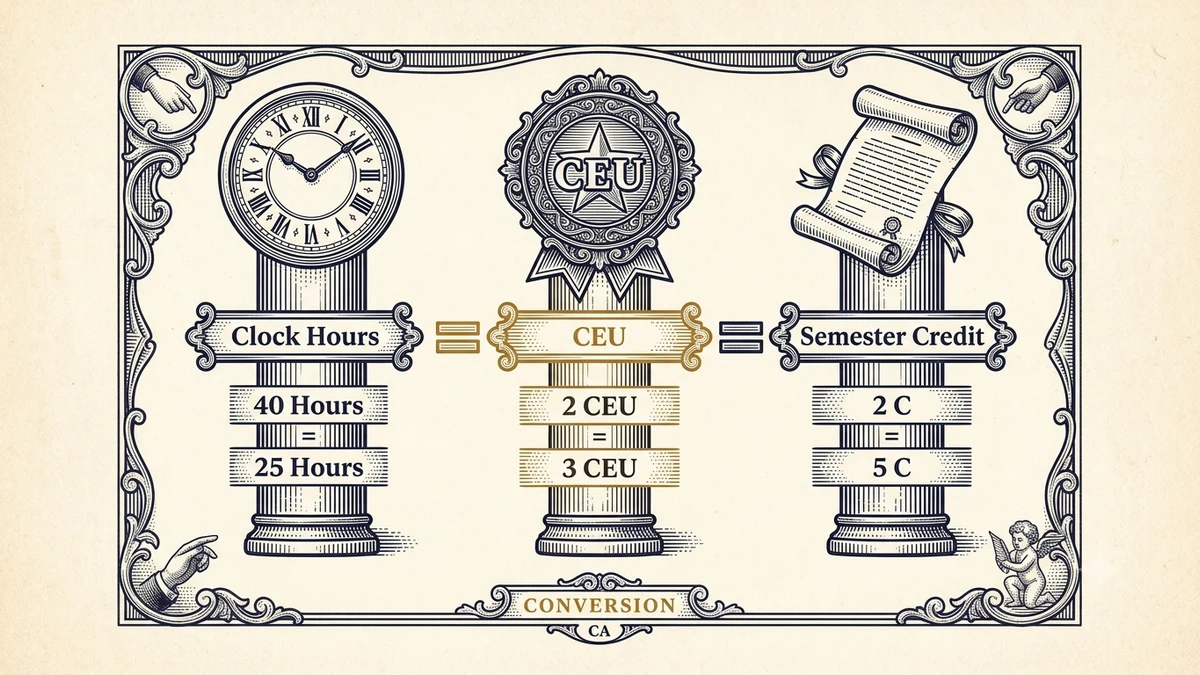
You can combine options. Ohio’s conversion chart equates one semester hour to 30 contact hours and one CEU to 10 contact hours. These are equivalent planning units, not a promise that any course or webinar qualifies. Activities must be connected to teaching or the license area and approved by the authority responsible for your plan.
| Planning choice | Common requirement | Approval and evidence |
|---|---|---|
| College coursework | 6 semester hours = 180 contact hours | Related to teaching/license area; transcript and LPDC approval |
| CEUs/contact hours | 18 CEUs = 180 contact hours | Related to teaching/license area; signed LPDC record/certificates |
| Equivalent activities or mixed plan | LPDC-approved combination | Must fit approved IPDP; activity receipts and exit form if changing districts |
| Not employed by an Ohio school | Direct coursework or participating ESC LPDC route | Arrange review route before enrolling or filing |
The credit units describe equivalent totals. Your IPDP and the responsible LPDC still determine which activity is approved.
Write the plan before taking the courses
If you work for an Ohio school, district, community school, chartered nonpublic school, or ESC that operates a Local Professional Development Committee (LPDC), the committee approves your Individual Professional Development Plan (IPDP). The plan should connect your professional learning to your needs, students, school, district, and Ohio educator standards. Submit it soon after the license is issued so the LPDC can confirm which activities fit before you invest time or money.
Keep the approved IPDP, dated approvals, completion certificates, and transcript together. District procedures may require preapproval, specific CEU forms, or periodic submissions. A course provider’s statement that an activity is “Ohio approved” does not replace your own LPDC’s decision under your IPDP.
When leaving a district or LPDC, request the signed Educator Leaving an LPDC Verification form before you go. It records the plan and activities approved by the former committee. Give it to the new LPDC or submit it with your state application if you no longer work in a school with an LPDC. Without the exit record, you may have to reconstruct whether previous activities were approved.
Choose the approval route that matches your employment
Employed educators normally apply through CORE and select the LPDC that will verify their plan. Send CEU certificates and supporting records to that committee as it directs; the state says these records go to the LPDC rather than being uploaded to CORE. Official transcripts are required when renewal is based on college coursework.
If you are not employed by an Ohio school, district, or ESC, you still have options. You can use six semester hours of qualifying coursework and apply directly, or ask a participating Ohio ESC LPDC whether it will review an IPDP and approve CEUs or equivalent activities. Availability and review requirements vary by ESC, so arrange that path early. Educators working in another state may be able to use professional development completed to renew a currently valid out-of-state standard license, with work-experience verification; if that state does not require renewal coursework or PD, Ohio’s coursework rule still applies.
File before October 1 of the expiration year
Ohio allows renewal applications for a currently valid five-year license beginning November 1 of the year before expiration. Meet the requirement and submit the application before October 1 of the expiration year. Under the current rule, missing that deadline generally raises the coursework requirement from six to nine semester hours. A license does not receive the normal six-hour rule simply because the educator completed six hours by June or applied before the license’s printed end date; the submission date is the key cutoff. Check the license-specific Ohio page and CORE application for any special-case instructions.
Before applying, check that your background checks are current, choose the correct LPDC in CORE, and make sure the LPDC has the course/CEU evidence it needs to make its recommendation. Retain the submission receipt and confirm the renewed credential appears with the expected grade bands and subject areas.
Check exceptions before repeating work
Some educators may qualify for a distinct route. A professional, lead professional, or senior professional teaching license holder who meets Ohio’s Consistently High Performing Teacher criteria may not need additional coursework or equivalent CEUs for the next renewal cycle. Professional license holders who earned National Board certification during the license term may renew with proof of valid certification. These are rule-specific exceptions; verify the credential and timing in the current Ohio instructions before relying on them.
Certain school pupil-services licenses can renew with a current license from the corresponding Ohio professional board. The list includes school audiologists, social workers, speech-language pathologists, school nurses, occupational and physical therapists and assistants; school counselors and psychologists may use a professional board license if they hold one. Other school counselors and psychologists must meet the applicable educator renewal requirements. Beginning in 2026, school counselors serving grades 7–12 also have a four-hour construction-trades training requirement. Pupil-services renewal has its own Ohio page, so do not apply the general teacher checklist without checking it.
If the license is lapsed
A lapsed professional or associate license usually requires nine semester hours related to teaching or the area of licensure, completed since the issue date of the license being renewed. Ohio’s rule has an exception for certain educators continuously employed during the lapsed period under another valid Ohio or out-of-state educator license; use the current state application instructions to document that case. Do not assume 180 hours alone will reinstate a lapsed license when the rule calls for coursework.
If the license has been expired for at least a year, an employing Ohio district may request a one-year, nonrenewable reinstatement license for an otherwise qualified educator. Its plan calls for nine semester hours or 27 CEUs/270 contact hours approved by the LPDC before that temporary license expires. This is a district-requested bridge, not a general extension, and it is distinct from ordinary renewal.
- Nov 1 before expiration year: CORE renewal applications open
- Before Oct 1 of expiration year: submit completed six-hour/18-CEU LPDC recommendation
- After Oct 1 cutoff: check nine-semester-hour rule and license-specific exceptions
- Already lapsed: verify nine-hour reinstatement route or documented exception
- Expired at least a year: employing district may request one-year nonrenewable bridge license
The October 1 application cutoff separates the ordinary six-hour route from the general nine-hour late/lapsed route.
A practical Ohio renewal checklist
- Confirm the credential is a five-year professional or associate license and note its issue/expiration dates.
- Write or update the IPDP and get approval from the correct LPDC before starting activities.
- Choose a qualifying mix: six semester hours, 18 CEUs/180 contact hours, or approved equivalents.
- Save completion evidence, transcripts, LPDC decisions, and an exit form if you change employers.
- Submit in CORE early enough to meet the October 1 expiration-year cutoff and confirm the LPDC recommendation.
- Check for a valid NBPTS, consistently high-performing, out-of-state employment, or pupil-services exception before taking extra courses.
- If already lapsed, follow the reinstatement requirements and do not confuse those with the normal cycle.
The useful Ohio shortcut is 6 / 18 / 180: six semester hours, 18 CEUs, or 180 contact hours. The practical rule is approval first, proof kept, and the CORE application submitted before October 1. A district transfer, a non-school job, or an expired license changes the approval path, so identify that path while there is still time to complete it.