A certificate might show contact hours, a workshop might award CEUs, and a university transcript might show semester credits. Those labels do not share one national teacher-license conversion table. The agency that renews your credential decides whether an activity qualifies, which unit it accepts, and how it converts that unit.
Keep the original award and evidence intact. Add a separate calculation only after you identify the receiving state’s rule, credential type, renewal cycle, and provider requirements. The examples below show why a familiar conversion can be wrong in another state.
First separate the units
A clock hour or contact hour usually describes time spent in instruction, but attendance alone does not make it eligible renewal credit. The state may require an approved provider, an approved topic, an evaluation, or a particular record.
A CEU is a continuing-education unit. Some education agencies define one CEU as ten contact or clock hours; others do not use commercial CEUs as a renewal unit. Check whether the agency means a defined unit, an agency-issued renewal credit, or simply a vendor’s label.
A semester credit hour is college credit recorded on an official transcript. States may convert it to professional-learning hours for one renewal process, but that does not turn every course into licensure credit. The school, course, grade, subject, completion date, and credential rules can still matter.
Other terms, including CPE hours, CTLE hours, PD hours, renewal points, PLUs, and inservice points, belong to particular systems. Treat the label as a clue to find the rule, not as a portable currency.
| Receiving-state rule (check credential scope) | Original unit or activity | Published renewal conversion |
|---|---|---|
| Texas college coursework | 1 semester credit | 15 CPE hours (TEA) |
| Illinois college coursework | 1 semester credit | 15 PD hours (ISBE) |
| Colorado college coursework | 1 semester credit | 15 contact hours (CDE) |
| Ohio renewal chart | 1 semester credit | 30 contact hours; 3 CEUs = 1 semester |
| North Carolina renewal | 1 CEU | 10 clock hours; 8 CEUs = 80 hours |
| Florida approved master inservice | 20 inservice points | 1 semester-hour equivalent |
Compare the state’s published formula
The same transcript can be assigned different renewal values by different agencies. These are examples of current, state-specific rules, not a national equivalency chart.
- Texas: TEA states that one semester credit hour equals 15 CPE hours. Standard classroom teachers generally need 150 CPE hours per five-year renewal cycle; qualifying provider, content, and activity limits still apply.
- Illinois: ISBE generally counts one approved professional-development hour as one clock hour. Its conversion for qualifying academic coursework is 15 PD hours per semester hour (and 10 per quarter hour). Use the Illinois provider and reporting rules as well as the arithmetic.
- Colorado: CDE’s renewal framework uses 15 contact hours per semester hour and 10 per quarter hour; the Professional Teacher License path is commonly 90 hours or six semester hours. The required content and license-specific rules still apply.
- Ohio: The State Board of Education conversion chart lists 1 CEU as 10 contact hours, 3 CEUs as one semester hour, and 30 contact hours per semester hour for its applicable professional-license renewal calculation. That is not permission to use Ohio’s ratio in another state or for a different credential.
- North Carolina: NCDPI describes a renewal unit of 1 CEU as 10 clock hours, with the standard renewal total shown as 8 CEUs or 80 clock hours. Confirm which activities qualify and how the complete renewal application must be documented.
- Florida: 20 inservice points in an approved Florida master inservice program equal one semester hour for renewal. “Approved” and “Florida master inservice program” matter: an unrelated provider’s points do not automatically receive that value.
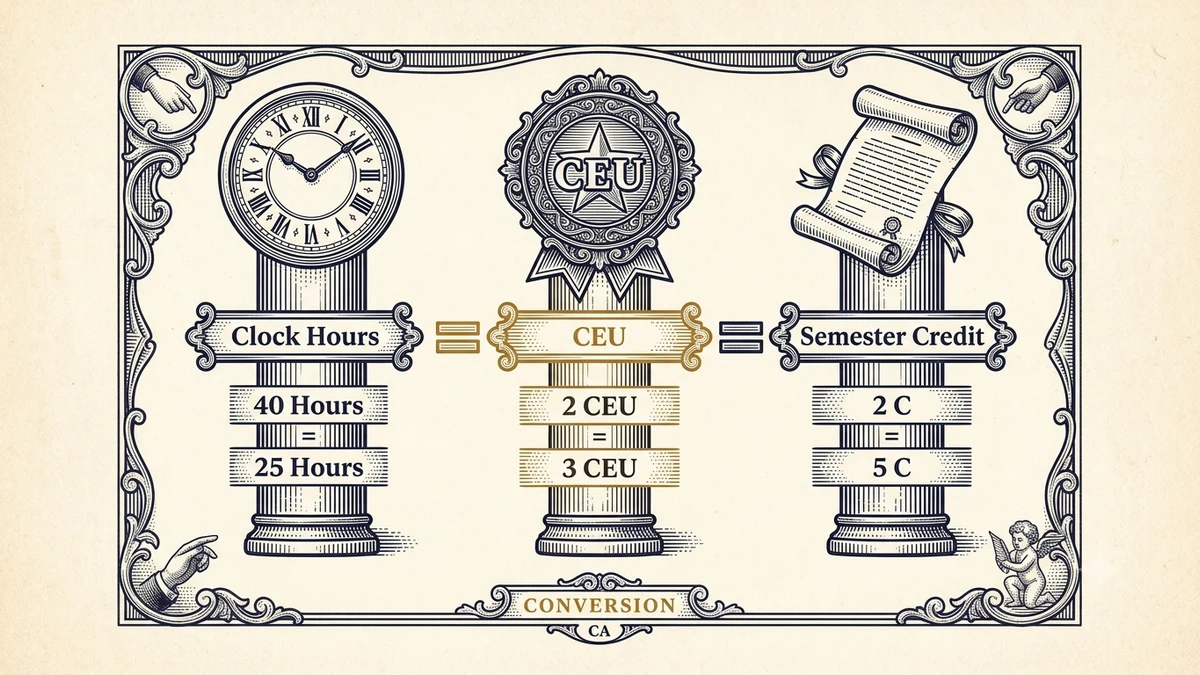
The comparison figure below keeps the source unit and receiving-state rule side by side. Do not copy a ratio out of the chart without opening the authority’s current instructions for your own license.
Keep source units and converted totals separate
Suppose a university transcript awards three semester credits. Your records should say 3 semester credits first. If you are renewing in Texas, a separate calculation may show 45 CPE hours under TEA’s formula, if the coursework otherwise qualifies. If you later apply in Ohio, that state will evaluate the original transcript under its own renewal rules; do not carry the Texas total over as if the university awarded 45 hours.
A practical ledger has these fields: activity and completion date; provider and approval evidence; original unit and amount; official conversion source and date checked; calculated renewal unit; category or topic; and the state and cycle where you intend to use it. Keep the original certificate, attendance record, or transcript with that entry. This makes later audits and state changes easier to explain.
Check these four things before you convert
- Receiving credential: Identify the state, certificate type, endorsement, and active renewal period. Requirements can differ by role and license tier.
- Activity acceptance: Confirm provider authorization, eligible subject matter, delivery format, grade, and completion window. A correct conversion does not repair an ineligible course.
- Exact formula: Find the licensing agency’s own page, rule, or conversion chart. Verify that it applies to educator-license renewal, not college billing, nursing CE, or another profession.
- Evidence and reporting: Save the source award and check whether the state requires upload, portal entry, employer verification, or an attestation with records kept for audit.
If the provider only promises “renewal credit,” ask which state rule and exact unit appear on the completion record. If the salesperson cannot identify them, pause before paying and check with the licensing agency.
Why generic conversion charts fail
Commercial pages often give a useful glossary or explain common formulas, but they cannot decide whether a course is accepted for every license. For example, a broad higher-education explanation that treats a semester credit as 30 contact hours may describe a general workload convention; it is not automatically the licensing formula. Ohio does use 30 contact hours per semester hour in its renewal conversion chart, while Texas, Illinois, and Colorado publish 15-hour formulas in the contexts described above. Always distinguish academic workload, continuing-education definitions, and a state’s credential-renewal rule.
Three reviewed competitor resources illustrate the boundary: Teacher Renewal Desk correctly warns against assuming CEU/CPE/CTLE/PDP units are universal and recommends keeping original evidence; LegalClarity explains clock hours versus academic credit but is not an educator licensing authority; Credits for Teachers discusses graduate-credit options and common hour equivalencies, but a vendor’s general statement cannot replace the state’s approval and conversion rules. Use them as orientation, then verify the formula with the relevant state agency.
Use a decision path, not a memorized ratio
Start with the credential that will receive the credit. If the agency does not publish a matching conversion, do not invent one from a neighboring state or a course seller’s calculator. Preserve the original unit and request written guidance from the licensing agency. After converting, keep both the calculation and its source next to the award. Recheck the official rule when a renewal cycle or credential changes.
The aim is not to memorize how many hours equal a CEU everywhere. It is to show, for every number in your renewal record, who awarded it, what the original unit was, and which current rule lets you count it.